 Plant
PlantMoraceae · Morphology
Ficus lyrata: the lyre-shaped leaf and the fig's hidden flowers
Ficus lyrata
Most people know Ficus lyrata by its leaf: large, leathery and shaped like a violin or a lyre. Fewer know that the plant’s flowers never come into view. They sit hidden inside the fig itself, and without one particular wasp the species never sets viable seed. That hidden flowering is exactly why a Ficus lyrata in a living room can live for decades without ever bearing fruit.
A leaf shaped like a lyre
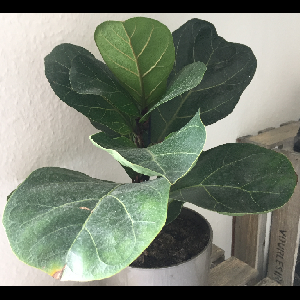
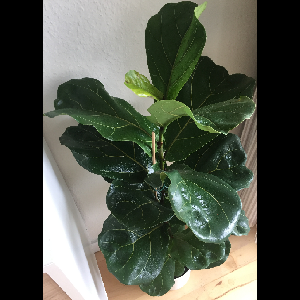
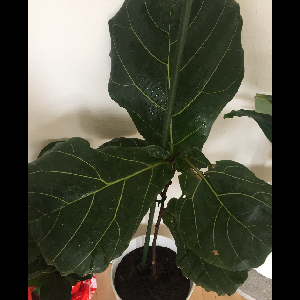
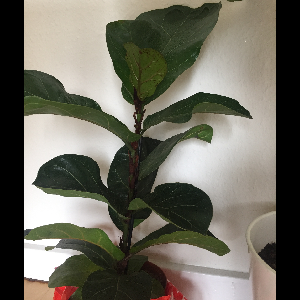
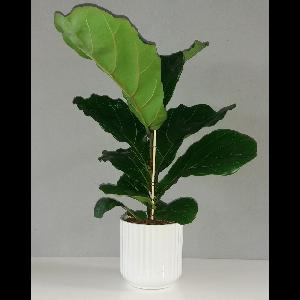
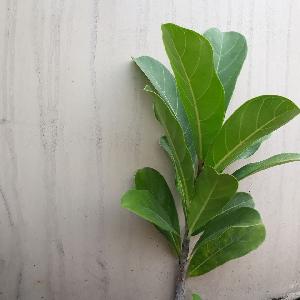
The species epithet lyrata refers to the shape of the leaf. The blade is broad and rounded at the top, often narrowed in the middle and widened again toward the base, so that the outline recalls a lyre or the body of a violin. The leaves are large, thick and leathery, with clearly sunken veins and a wavy margin. It is this feature, not the flowers, that people recognise the species by, because under indoor conditions it essentially never blooms. The leaves are borne alternately along the branches and, on a well-established tree in the wild, become considerably larger and heavier than on the young plants sold in trade, a trait the species shares with many trees whose juvenile and adult forms differ markedly.
The species was described scientifically by the German botanist Otto Warburg in 1894 (Warburg 1894). It belongs to the mulberry family Moraceae and to the large genus Ficus, which holds some 800 species across several subgenera. Ficus lyrata is placed in the subgenus Urostigma, section Galoglychia, the African branch of the so-called strangler figs (figweb).
Like all members of the Moraceae, Ficus lyrata carries a white, milky sap (latex) in all its parts, which flows out when they are broken. The growing point at the shoot tip is enclosed by a rolled stipule that falls off and leaves a distinct ring-shaped scar around the branch at each new leaf. This is a hallmark of the whole genus Ficus, and the cup-shaped stipules are exactly what gave the name to the section Cyathistipulae, to which the species belongs (figweb).
From West Africa’s rainforest, as a hemiepiphyte
The species’ natural range is western and west-central tropical Africa. According to Plants of the World Online, it runs from Sierra Leone in the west to Cameroon and Gabon, with occurrences in Ghana, Nigeria, Ivory Coast and Liberia among others, in lowland tropical rainforest (POWO). That is a very different light and climate from a windowsill, and the species’ growth form is shaped by the forest.
Ficus lyrata is a hemiepiphyte (POWO). The seed often germinates high up in the crown of another tree, where a bird or mammal has left it, and the plant sends aerial roots down toward the forest floor. When the roots reach the ground and thicken, they can in time enclose the host tree. This is the growth habit that earned the subgenus Urostigma the nickname strangler figs: the host is not killed by poison but by a net of roots that tightens as the fig grows large. Not every individual ends as a true strangler, but the ability to begin life high up and only later reach the ground runs through the whole group.
The fig flower and the wasp it cannot do without
What we in everyday speech call a fig is not a fruit but an inflorescence turned inward. In botanical terms it is a syconium: a fleshy, nearly closed structure in which hundreds of tiny flowers line the inside. The only way in is a small opening at the top, the ostiole, which is packed with scales.
Ficus lyrata is monoecious, that is, it carries both male and female flowers in the same fig. Pollination rests on one of nature’s most specialised partnerships. All figs are pollinated by small wasps in the family Agaonidae, and as a rule each Ficus species has its own wasp species that pollinates no other fig (figweb). A mated female wasp, often only a few millimetres long, forces her way in through the ostiole, pollinates the female flowers and at the same time lays her eggs in some of them. Without the partner wasp there is neither pollination nor viable seed.
Inside the fig the female flowers are not all alike. Some have long styles that the wasp cannot reach the base of with her ovipositor, and these develop into seeds. Others have short styles, where the wasp lays her eggs, and these become galls that house the larvae. The balance between seeds and wasps is the price both parties pay for the partnership. The female wasp often loses her wings as she forces herself through the narrow opening, and dies inside the fig once the eggs are laid.
The symbiosis is ancient. Figs and their wasps have evolved together for tens of millions of years, in one of the closest mutual dependencies known between a plant and an insect (Machado et al. 2001). That also explains a very practical thing: the partner wasp does not occur in Europe or anywhere far from the species’ homeland, and so a Ficus lyrata outside the tropics never sets seed. Every specimen sold as a houseplant is propagated vegetatively from cuttings or layers, not from seed.
The genus Ficus is regarded as a keystone in many tropical forests. Because different species bear figs at staggered times of year, there is almost always ripe fruit somewhere, and it becomes a stable food source for birds, bats and monkeys when other food is scarce. In return the animals disperse the seeds. For a hemiepiphyte like Ficus lyrata that dispersal is decisive, since the seed should ideally end up high in a tree crown in order to germinate in the right place.
There is no fixed, widely used English folk name for the species in our data beyond the descriptive fiddle-leaf fig, named after that violin-shaped leaf which makes it so easy to recognise, and which is the only thing most people ever see of a plant whose real flowering takes place out of sight. The correct name is in any case the scientific one, Ficus lyrata.
Sources
- Warburg, O. (1894). Ficus lyrata. Via World Flora Online: https://www.worldfloraonline.org/taxon/wfo-0001084874
- Plants of the World Online (POWO), Kew. Ficus lyrata Warb. https://powo.science.kew.org/taxon/urn:lsid:ipni.org:names:853158-1
- GBIF Secretariat. Ficus lyrata Warb. GBIF Backbone Taxonomy. https://www.gbif.org/species/5361899
- figweb: Berg, C. C. & Wiebes, J. T. et al. Ficus lyrata (subgenus Urostigma, section Galoglychia). https://www.figweb.org/Ficus/Subgenus_Urostigma/Section_Galoglychia/Subsection_Cyathistipulae/Ficus_lyrata.htm
- Machado, C. A. et al. (2001). 60 million years of co-divergence in the fig-wasp symbiosis. https://pmc.ncbi.nlm.nih.gov/articles/PMC1559977/
Photos
In the app